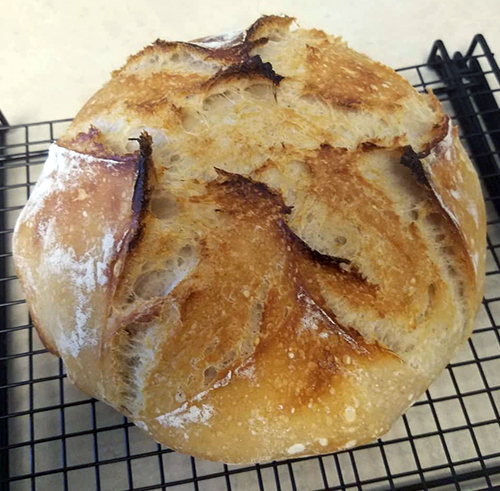
I recently got an enameled cast iron Dutch oven. The instructions say not to heat it empty, which is something many bread recipes call for. Further research told me that sudden temperature changes can also be bad for the longevity of the enamel, and I came across people suggesting that the bread should go into a cold oven near the end of the proofing time. Then the oven goes on and the pot heats as the oven does, and the bread finishes proofing before beginning to bake.
If I had not already made a recipe before that began in a cold oven I may have been more skeptical, but I figured—why not? In my experience, bread is pretty forgiving. Even if you screw it up, it’s pretty hard to make it inedible. It might look weird or the texture might not be very good but it will probably taste delicious anyway. And if it’s not, it can most likely be used to make croutons or bread crumbs.
I’ve been making sourdough bread every few weeks for a while now, though my starter has not been very active recently, perhaps due to the cold weather, and I have not been getting a good rise. Since I started using my Dutch oven, my loaves have been pretty dense, though still delicious. They’ve also had an extremely thick crust on the bottom though, which is not ideal. There are a few factors that could be contributing to this and they should probably be addressed fully in a separate post.
I will just say that my oven tends to overcook things on the bottom before they are cooked through, and to mitigate this I have a baking tray in the bottom of my oven to help circulate heat. For this particular loaf I lined my Dutch oven with baking paper, on top of a thin layer of semolina. I also added half a teaspoon of yeast to my usual recipe to give it some help rising.
About 10 minutes before my loaf was proofed, I scored it (something I still need practice with) and put it in my Dutch oven, which I put in the oven before turning it on to 450F. My recipe calls for 45 minutes with the lid on followed by 15 with it off, so I did the 45 before checking, thinking it may need more than another 15 minutes. I was instantly surprised by how well it had risen in comparison with my last couple of loaves, though I suspect that is from the added yeast rather than the cold start. It only needed another 20 minutes and it was done, though next time I will do 40 min covered so that there is more time to brown.
Obviously this is not a perfectly controlled experiment, but when my starter is doing better I’ll do some more attempts without yeast and see how they fare. Either way I’m confident that the cold start method works fine, though it may result in a longer cooking time. I’m just not certain whether it contributes to a better rise.
 My Food Journey
Leave a comment